

On this page
AI strategy consultants are outside advisors who help an organization decide where AI will pay off, what data and controls it needs first, and how to roll it out. A good AI strategy consultant leaves you with ranked use cases, a roadmap, success metrics, and a budget. A focused roadmap from a specialist typically costs five figures, and global firms charge far more.
The work sits between the boardroom and the engineering team. A consultant tells you which problems are worth solving with AI, then checks whether your data, security, and people can support the answer. The best ones stay close enough to delivery that the plan survives contact with your real systems.
BrainTrust Partners has advised mid-size and large organizations on AI, data strategy, and engineering since 2016, so we have seen good and bad engagements from the inside. This article covers what AI strategy consultants do, how to choose one, the main types of firms, what they cost, and the red flags to avoid.
Why organizations hire AI strategy consultants
Organizations hire AI strategy consultants because the hard part of AI is deciding what to build and getting data ready, not picking a model. Most leadership teams already have ideas. What they lack is a ranked, costed plan and an honest read on whether their systems can support it.
What an AI strategy consultant does
The core job is turning ambition into a defensible roadmap. Typical deliverables include:
- A data landscape assessment covering data quality, governance, and current workflows
- Use case discovery, prioritized by value and feasibility
- A roadmap with success metrics, timeline, and budget requirements
- Security, privacy, and compliance guardrails for the systems you plan to run
- Build, buy, or partner recommendations
- Ongoing monitoring so models stay accurate after launch
When you need one
You need an AI strategy consultant when your data is fragmented across disconnected systems, when leaders disagree on priorities, or when you operate in a regulated field such as financial services, healthcare, legal, telecom, or automotive retail. You probably do not need one to launch a single, narrowly scoped tool.

The test is the price of a wrong decision. If a bad bet would waste six figures or expose customer data, pay for the plan first.
A strategy engagement is cheap insurance against building the wrong thing on data that is not ready.
How to choose an AI strategy consultant
Choose the consultant who can show relevant sector experience, real data engineering depth, and a plan you fully own. Polished slides are easy to produce. Proof of delivery is not.
Six criteria to check
Score every candidate against the same list:
- Sector experience. Have they worked in your industry and under your regulations?
- Implementation depth. Do engineers and data scientists sit on the team, or only strategists?
- Data capability. Can they assess and fix data quality, not just talk about it?
- Security and compliance. Do they plan for IP protection, privacy, and rules such as the FTC Safeguards Rule where they apply?
- Ownership. Do you keep the code, data, and plan, with no vendor lock-in?
- Named team. Will the people you meet do the work?
Certificates and courses matter less than shipped work. Ask what the consultant built and how it performed a year later.
Questions for the first call
Ask these and listen for specifics:
- Which use cases did you decline to pursue for a client, and why?
- How do you measure success, and what metrics will you commit to?
- What will you need from our data before you can estimate anything?
- Who owns the roadmap and the systems when you leave?
- What happens after launch to prevent model drift?
Vague answers to concrete questions are the clearest sign you are talking to a sales deck.
Types of AI strategy consultants compared
AI strategy consultants fall into four groups: global strategy firms, Big Four networks, boutique specialists, and independents. The right one depends on your size, your risk profile, and whether you need advice or delivery.
Big firms versus boutiques
People often ask who the "big 4 strategy consultants" are. Strictly, the Big Four are Deloitte, PwC, EY, and KPMG, which are accounting and advisory networks. The best-known pure strategy firms are McKinsey, BCG, and Bain.

| Type | Best for | Tradeoff |
|---|---|---|
| Global strategy firms (McKinsey, BCG, Bain) | Board-level transformation across a large enterprise | Highest fees, broad scope |
| Big Four (Deloitte, PwC, EY, KPMG) | Large programs tied to risk, audit, and compliance | Scale over specialization |
| Boutique AI and data consultancies | Mid-size and regulated companies that want hands-on build | Narrower brand, smaller bench |
| Independent freelancers | Bounded advice on one question | Capacity and quality vary widely |
Where independents fit
Independents work well for a second opinion or a short, defined task, such as reviewing a vendor proposal. Be careful when one person is asked to own data engineering, security, and change management at once. The market has attracted many people whose only qualification is prompt experience, so check their delivery history.
Match the firm to the size of the decision, not to the size of the brand.
What AI strategy consultants cost
AI strategy consultants charge hourly or day rates, a fixed fee for a defined roadmap, or a monthly retainer. Rates vary by firm type, so ask for the pricing model and the deliverable before you compare quotes.
How consultants price the work
Each model has a use. Time and materials suits open-ended advisory. A fixed fee suits a roadmap with a clear output. A retainer suits ongoing governance and monitoring. An individual's salary is a different number from a firm's rate, because the rate also covers overhead and delivery staff.
Budget implementation separately. A good roadmap gives you that estimate, with time, materials, and cost, before you commit.
A worked example
Say a mid-size company needs a roadmap. At an assumed $250 per hour, 80 hours of discovery and planning comes to $20,000. For comparison, the BrainTrust AI BluePrint Builder costs $15,000 for a six-month term, about $2,500 per month, and $25,000 for twelve months. The second six months adds $10,000.
The BluePrint includes up to four hours to brief you, and the plan can be used with any vendor. You can also reuse the system monthly for leadership planning, QBRs, and annual budgeting.
Compare quotes on what you keep at the end, not on the headline rate.
Red flags and what a good engagement looks like
A good engagement ends with decisions you can act on, and a bad one ends with a deck. You can spot the difference early.
Red flags to walk away from
- The pitch starts with a tool or demo instead of your goals and data
- No questions about data quality, governance, or security
- A generic roadmap with no metrics, timeline, or budget
- Black-box models or terms that lock you into one vendor
- Senior people sell the work and junior people you never met deliver it
- No named past results you can discuss
A healthy engagement, step by step
Strong engagements move in three stages. Discovery maps workflows, data, and goals, then ranks use cases. Build delivers the systems on proven infrastructure. Grow monitors performance and refines models so accuracy holds.
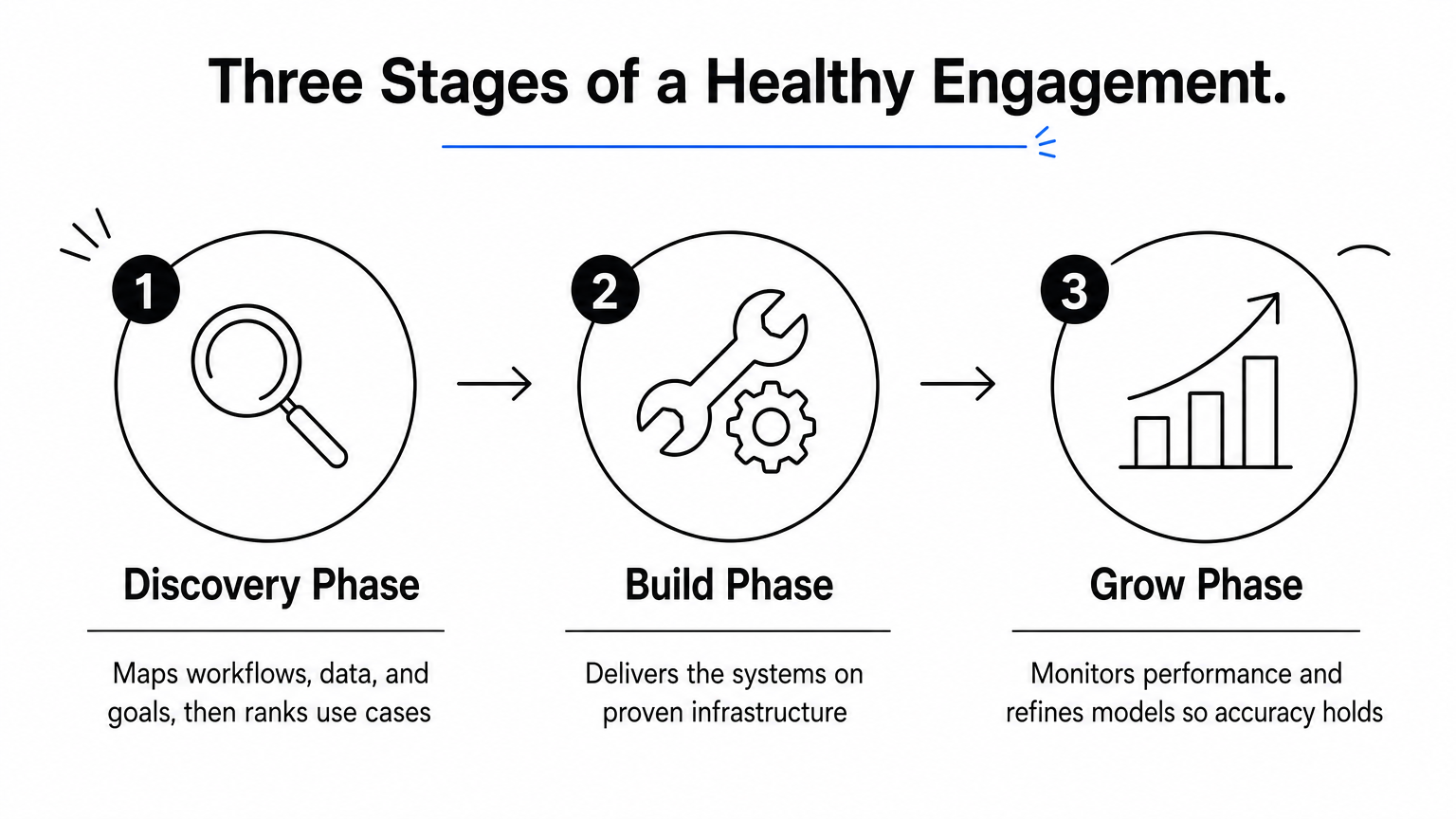
At BrainTrust Partners, that is how work runs, with engineers embedded in client teams and clients owning the code, the data, the insights, and the decisions. Whoever you hire, expect that same shape.
The right consultant leaves you with a plan you could hand to any vendor and systems you control.
Choosing your AI partner
AI strategy consultants earn their fee when they turn vague ambition into ranked use cases, honest data findings, and a budget you can defend. Choose on sector experience, implementation depth, and ownership of the result, and use the questions and red flags above to test every candidate the same way.
If you want to see what a roadmap built on those principles looks like, talk with the BrainTrust Partners team about your data, your goals, and where to start.