

On this page
AI and consulting now describes two overlapping things. Consulting firms use AI to do their own work faster, and AI consulting is the advisory and engineering service that helps organizations plan, build, and run AI systems. The short answer to the common worry is that AI is not ending consulting. It is changing what clients pay for, away from research and slide production and toward judgment, data readiness, and accountability for results.
This article explains why the shift is happening, how consultants and firms use AI day to day, what an AI consulting engagement includes, and what it means for consulting jobs. You will get a table of where AI fits in a project, a worked cost example, and a clear view of which skills keep their value.
BrainTrust Partners has worked as an enterprise AI, data strategy, and engineering consultancy since 2016.
Why AI is changing consulting
AI matters to consulting because it makes the cheapest part of the job, gathering and summarizing information, close to free. That forces firms and clients to rethink what a consulting fee actually buys.
Where the old model feels the pressure
Traditional firms run on a pyramid. Many junior analysts do research, spreadsheets, and decks, and a few senior people direct them. AI tools now summarize reports, clean datasets, and draft first-pass slides in minutes.

That squeezes the hours billed for junior work. Clients notice, and they ask why a project that once took ten weeks of analyst time should still be priced the same way.
Is consulting going away?
No, but the mix of work changes. A model can analyze a market. It cannot sit with an executive team, resolve a dispute between two business units, or answer for the outcome when a recommendation fails. Judgment and accountability stay with people.
Demand also grows in one area. Companies need help deploying AI itself, with messy data, security questions, and unclear priorities. That is why AI consulting exists as its own category. The work that shrinks is the work that was already commodity.
AI does not remove the need for consultants. It removes the need to pay for information that is now cheap.
How consultants and firms use AI
Firms use AI across four stages of a project: research, analysis, deliverables, and knowledge management. A human reviews every output before it reaches a client.
Where AI fits in a typical project
This is what AI management consulting looks like in practice. The work is the same, compressed, with people moving up the value chain.
| Project stage | What AI does | What the consultant still does |
|---|---|---|
| Research | Summarizes reports, filings, and interview transcripts | Chooses sources and checks claims |
| Analysis | Cleans data, finds patterns, runs scenarios | Frames the question and tests whether a pattern makes business sense |
| Deliverables | Drafts decks, memos, and first-pass models | Sets the story, makes the recommendation, owns quality |
| Knowledge management | Searches past engagements and proposals | Decides what is reusable and what is confidential |
Governance and risk
Pasting client data into a public tool is the fastest way to create a confidentiality problem. Firms need written rules on which tools are approved, what data may go in, and who reviews the output.

Models also state wrong numbers with confidence, so every figure and citation needs checking. Many clients now prefer private systems that run only on their own data, which keeps intellectual property and customer information inside their control.
Speed is the easy gain from AI in consulting. Trust is what has to be engineered.
What AI consulting services involve
AI consulting combines advice and engineering. It helps an organization decide where AI pays off, prepare its data, build the systems, and keep them accurate over time.
The three stages of an engagement
Good engagements follow a sequence. BrainTrust Partners uses Discovery, Build, and Grow.
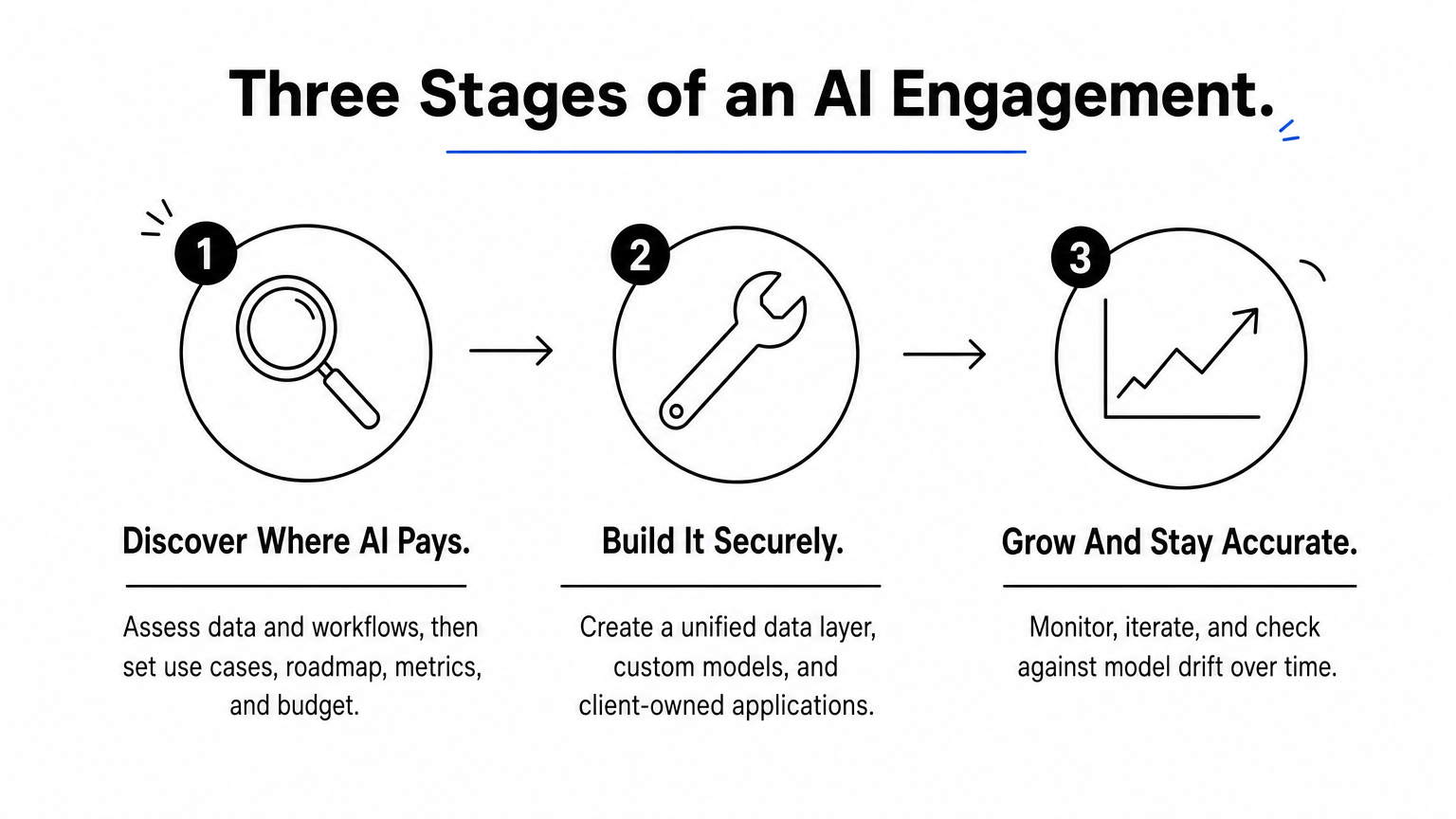
| Stage | Question it answers | Typical output |
|---|---|---|
| Discovery | Where will AI pay off? | Data and workflow assessment, prioritized use cases, a roadmap with metrics and budget |
| Build | How do we make it work securely? | Unified data layer, custom models, applications the client owns |
| Grow | How do we keep it accurate? | Monitoring, iteration, and checks against model drift |
The unglamorous part is usually data readiness. Most mid-size and large organizations have records spread across disconnected systems with conflicting schemas, and no model fixes that on its own. Smaller businesses can start the same way, with one workflow and one data source instead of a company-wide program.
What it costs and how long it takes
Costs depend on scope, so it helps to see one provider's published figures.
| Offering | Term | Price |
|---|---|---|
| BrainTrust AI BluePrint Builder | 6 months | $15,000 |
| BrainTrust AI BluePrint Builder | 12 months | $25,000 |
| BrainTrust IXP | 12-month term, per location | Starting at $3,000/month |
| BrainTrust IXP | 24-month term, per location | Starting at $2,500/month |
Take a dealer group with three locations. It starts with the BluePrint at $15,000 for a roadmap built from an average 60-minute leadership deep-dive, and the plan can be used with any vendor. If it then adopts IXP on a 12-month term at the starting rate, that is 3 x $3,000 x 12 = $108,000 for the first year. On a 24-month term at $2,500, it is 3 x $2,500 x 12 = $90,000 per year. IXP reaches initial use cases in 60 to 90 days, and a Snowflake-based engagement runs three to six months depending on existing systems.
Pay for a roadmap before you pay for a build, and make sure you own what you get.
What AI means for consulting jobs and careers
AI shrinks entry-level research work and raises the value of people who pair business judgment with technical fluency. The career path still exists, but the first rung looks different.
Skills that hold their value
The skills that last are the ones a model cannot be held accountable for:
- Problem framing: deciding which question is worth answering.
- Data literacy: judging whether a model's output is sound.
- Change management: getting teams to adopt a new workflow.
- Domain depth: knowing regulated industries such as financial services, healthcare, or automotive retail.
Hybrid roles are growing, such as engineers and strategists embedded with a client team. Pure slide production is the skill to worry about.
What about AI consulting salaries?
Pay varies widely with seniority, employer type, and specialty. A partner at a large firm, a boutique engineer, and an independent adviser earn very differently. Roles that mix strategy with hands-on engineering are in demand, but no single number is reliable.
Check current salary surveys and the Bureau of Labor Statistics data for management analysts before you benchmark an offer. Treat any one figure from a forum thread as an anecdote.
The safest consulting career bet is to become the person who can judge AI's work, not the person who competes with it.
Where AI and consulting go from here
Consulting is not disappearing. The cheap parts of the work are being automated, and the valuable parts are judgment, data readiness, secure delivery, and ownership of results. Firms that use AI well deliver faster, and clients who buy AI consulting well keep control of their data and systems.
If you are deciding where AI belongs in your own organization, start with a clear roadmap before any build. You can talk with the BrainTrust Partners team about an assessment and a plan you will own.